
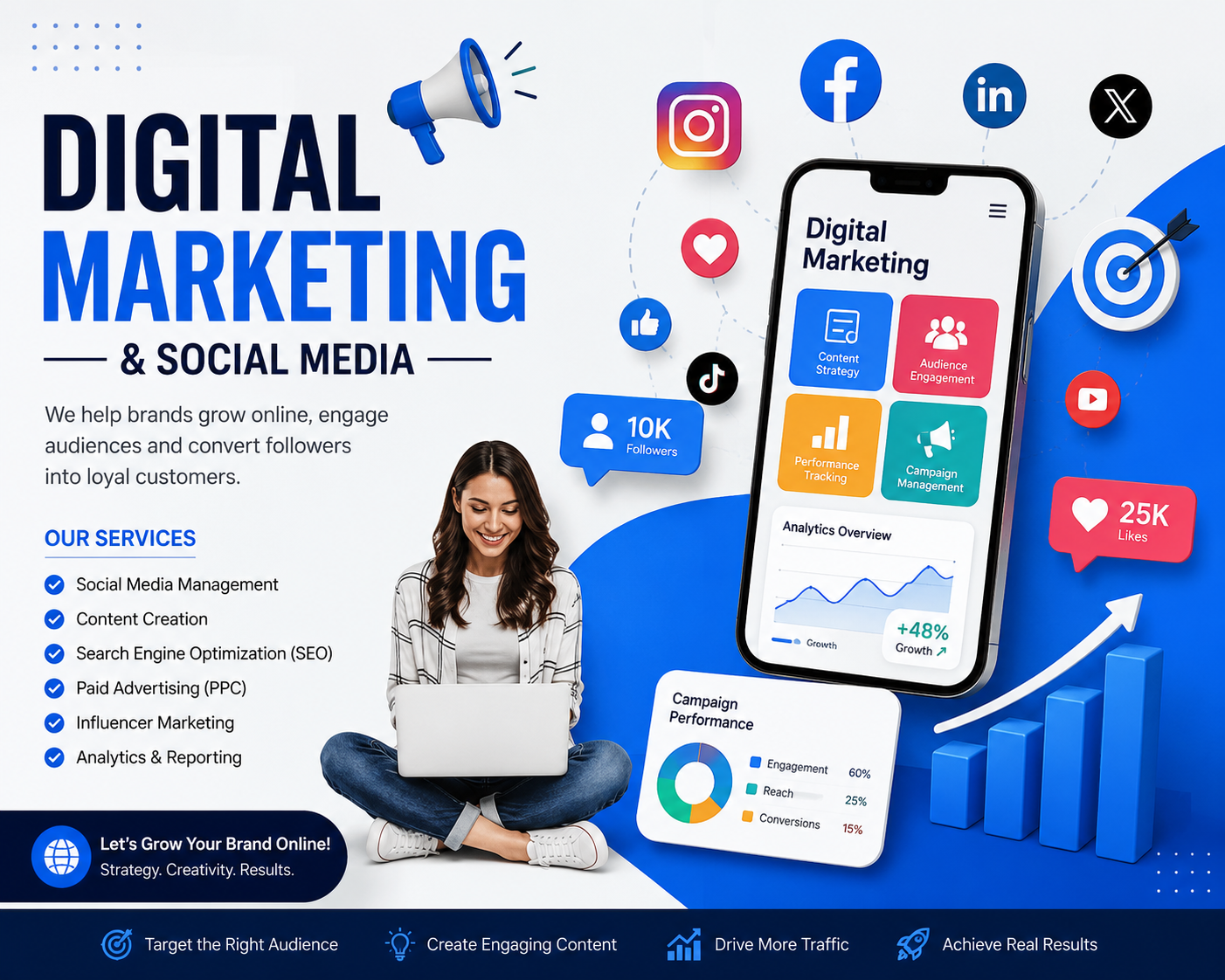
Introduction
Over 170 million people use social media regularly and this magnitude of social media adopters and
users make it obvious that every working professional is or should be familiar with the basic tenetsof Digital Marketing.
In simple terms, Digital Marketing is the promotion of products over the internet or any form of
electronic media. According to the Digital Marketing Institute, “Digital Marketing is the use of
digital channels to promote or market products and services to targeted consumers and businesses.”
Digital content is being consumed by people with cheerful alacrity. It is expected that the traditional
marketing platforms such as newspapers, magazines or billboards will soon be relegated to oblivion.
Digital marketing presents several attractive advantages and at the same time it is pocket friendly as
well, which is encouraging enough that majority of marketers have started patronizing it.
Digital Marketing helps in reaching out to a larger audience in very short time at minimal costs.
In 1993, the world’s first clickable banner went live, after which HotWired bought a couple of banner
ads for advertising. This denoted the start of the shift towards digital era of advertising. Due to this
shift, the year 1994 witnessed several advancements in the digital realm. Exactly the same year, Yahoo was born.
Otherwise called “Jerry’s Guide to the World Wide Web” after its organizer Jerry Yang, Yahoo got
nearly 1 million hits the very year. This incited phenomenal changes in the digital marketing
landscape, with organizations streamlining their sites to rake in higher web search rankings. 1996
saw the birth of two or three more web indexes and apparatuses like HotBot, LookSmart, and Alexa.
1998 saw the introduction of Google. Microsoft created the MSN web index and Yahoo introduced
web search. After two years, the web bubble burst and all the more modest web search tools were
either abandoned or cleared out leaving more space for the goliaths in the business. Not one to be
left behind, Microsoft set MSN aside and launched Live Search to contend with Google and Yahoo.
Then, at that point, Web 2.0, was launched/introduced where individuals turned out to be more
dynamic members as opposed to staying latent clients. Web 2.0 permitted clients to communicate
with different clients and organizations. Labels like ‘super information highway’ started to be applied to the web.
Soon, social networking sites started to emerge. MySpace was the first site to show up, followed by
Facebook. Many organizations understood this to be the future of marketing and started making
changes in their marketing strategy in this direction. With new digital assets, they required new ways
to promote their brands and take advantage of social media platforms.
1.1 5 Ds of Digital Marketing
Digital Devices laptops, desktops, smartphones, tablets, smart TVs, wearable devices,
gaming devices.
Digital Platforms social media, search engines, websites
Digital Media online ads, social media marketing, SMS, email marketing
Digital Data apps, contact forms, surveys
Digital Technology artificial intelligence, virtual reality, augmented reality
1.2 Digital Consumer Digital Marketing and Social Media
A simple question that may baffle us is “Who are digital consumers”? Are they someone who are
technologically superior living on a different planet? Let us understand this concept in the simplest
form. In simple terms, people who use technology to buy and sell products and services are known
as digital consumers. They are the same people who order a pizza on an app and may also seek some
discount coupons to make such purchases. It can also be you who is accessing this reading material
from our online platform.
The need for communication has existed for ages and it has only been the technology used for
communicating has changed or rather evolved. In the field of digital marketing, it is important to
keep a tab on the evolving technologies that are being used for communications. The behavior of
consumers is continuously changing because of the advent of digital technologies, which have made
the access to information quite easy and quick.
.
1.3 Behavioral Traits of a Digital Consumer
Extensive corpus of research that exists today in this field has unearthed the behavioral traits of a
digital consumer. They are as follows:
- Digital-savvy consumers are well informed
- Digital consumers have learned to harness the power of internet to the full extent. As technologies
evolve, these consumers learn to harness the power of digital technologies to the maximum extent
and also the most efficiently. So, we can safely conclude that the marketers have to go that extra mile
to reach out and impress these well-informed consumers.
2.Need relevant and quick information
Sources of information are rife and thus people have become accustomed to get right solutions and
information within fractions of a second. So this could mean that if your website takes time to load,
then the digital-savvy consumer will hop to the next possible option. It is that instant “WOW” that
you site or app creates is the decisive factor that makes this digital consumer love you or ditch you.
3.They share a lot
The digital consumer is bestowed with unlimited options and platforms where they share their
knowledge, opinions, experiences, ask for recommendations, express their frustrations, share
reviews and may also leave comments. So, this user generated content (UGC) or we can also say the
earned media plays a crucial role in the success or disaster of your vent
1.4 How to Engage with a Digital Consumer
In today’s tech-driven world, businesses need to catch up quick with the shifts in consumer habits
and behaviors. They also need to keep a tab on the new digital consumer engagement trends to
ensure they achieve the digital marketing objectives. Here are a few pointers which need to be
incorporated in a digital marketing engagement strate
1.Leverage the power of social media
The power of social media is phenomenal and
brands can easily forge their identities and personalities across all demographics. It is no longer
a mere platform to connect with the audience, rather social media has evolved into a digital
space to engage with the consumer through support channels, live chat, sharing content,
sharing content and more.
2.Behaviour – based messaging Digital Marketing and Social Media
Stronger engagement strategies can be used with the help
of technologies. Businesses can engage with consumers through live chat to build stronger
engagement strategies. Live chat is no longer for real-time support. It can also be used to observe
and respond to consumer behavior. Such information can be used to map the consumer’s future
journey. Technology can be used to understand consumer’s website or mobile app behavior,
which can be used to make future interactions more relevant.
3.Personalization
Personalization has been in vogue in marketing circles and it is very
subjective and varies from business to business. For some it may just be addressing the customer
with their first name, for some it can be just addressing the customers in an email with their
first name. Some businesses have taken it to the extent of creating target segments and engaging
with them in the most relevant manner. Personalization is all about harnessing all the data at
disposal in order to determine the patterns in behavior and understand what they want to see.
This allows you to direct specific, valuable content or messages towards specific customers at
different stages of their journey. This can definitely improve the clicks through rate and may
also help in increasing the revenue and subsequently profits.
4,Provide customers with self-service options
Customers have become very demanding
and want a seamless experience and self-service options have come in very handy in providing
that seamless, highly-integrated overall engagement experience. Providing self-service
solutions for your consumer empowers them to find their own answers and resolutions and
improves digital consumer experiences thus driving future brand engagement by building
trust.
5.Know what drives your customers Digital Marketing and Social Media
It is important to collect feedback from customers.
This is crucial in your engagement strategy. It helps you in understanding what triggers your
customers in making purchase decisions and taking other important decisions. It also helps you
in understanding what the consumers think about you, your products or services.
*:I hope you learn a lot from it and part 2 will continue soon
Discover more from Egere Market
Subscribe to get the latest posts sent to your email.


good
good